• Charging solutions
    • Home charging
      • Zaptec Go
      • Zaptec Go 2
    • Commercial & shared charging
      • Zaptec Pro
    • Load balancing
    • Zaptec App
    • Zaptec Portal
    • Accessories
  • For partners & installers
    • Documents & manuals
    • Partner webshop
    • Partner marketing material
    • Existing partners & installers
    • Training courses
    • Become a partner
    • Integrations with Zaptec
  • Info Hub
    • Tips and tricks
    • Case studies
    • Industry news
    • Inside Zaptec
  • Need help?
    • Documents & manuals
    • Help Centre
    • Contact us
  • Company
    • About us
    • Our journey
    • Quality and safety
    • Sustainability commitments
    • Investor relations
    • Careers
  • Find an installer
  • Become a partner
Get ZaptecGet Zaptec

Explore our solutions

Get ZaptecGet Zaptec
Charging SolutionsPartners & installersZaptec portalDevelopersSupportDocuments & manualsInfo HubSecurityCompanyInvestor RelationsPressPrivacy PolicyCookie PolicyTerms and conditions
FacebookInstagramLinkedInTikTokYouTube
  1. Home /
  2. Info Hub /
  3. Industry news /
  4. Europe’s EV shift: Early days, big opportunities

Europe’s EV shift: Early days, big opportunities

By Eirik Fjellså Hærem, CFO and Deputy CEO at Zaptec 

When you read headlines about an “EV slowdown”, it can almost feel provocative to say that Europe is still early in the adoption of electric vehicles. But if you look at the numbers, that is exactly where we are. 

CFO and Deputy CEO at Zaptec, Eirik Fjellså Hærem. / Photo by: Line Owren

Related:

Industry news

When neighbourhoods become batteries: Lessons from a Danish V2G village

Industry newsTips and Tricks

The real cost of charging your electric vehicle at home

Industry news

Why verified EPDs matter more than slogans in sustainability

Article metadata

Tags:
  • Industry news
Date:
20.05.26
Read time:
6 minutes
Share:

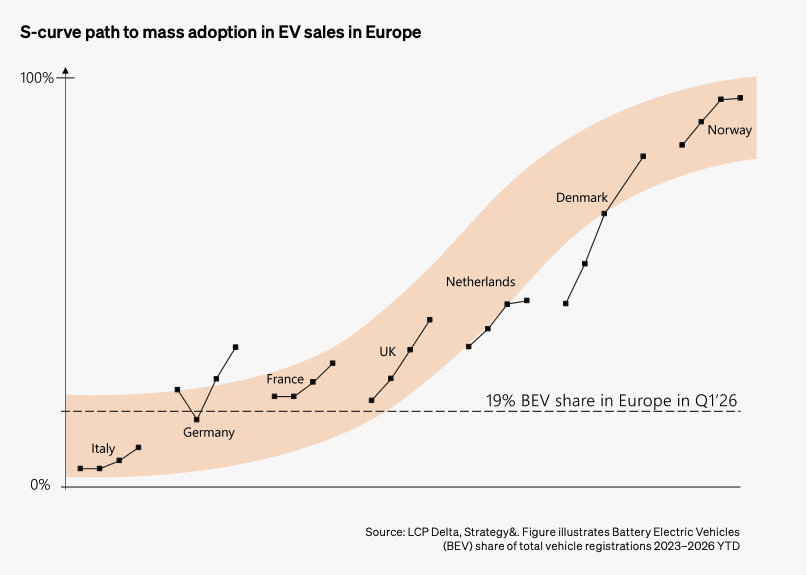
In the first quarter of 2026, over 19 per cent of all new cars sold in Europe were fully electric. That is impressive growth in a short time, but still far from where we know the market is heading. Some countries have moved from pioneers to early majority, while Europe as a whole is still in the steepest part of the S curve. 

This is where our opportunity lies. 

Driving electric has become the rational choice

The most important point is this. Choosing an electric car is no longer an idealistic niche decision. For most buyers it is the economically rational one. 

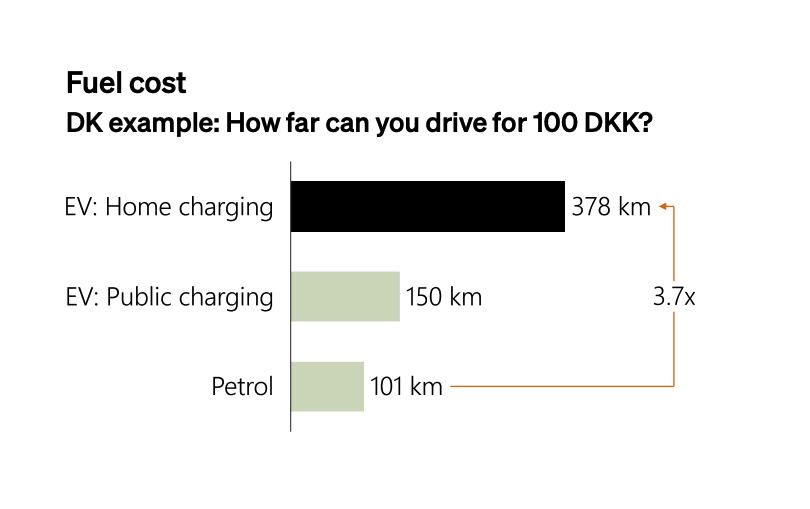
Take Denmark as an example. For 100 DKK, you can drive around 378 kilometres with an EV charged at home. Using public charging, you reach roughly 150 kilometres. In a petrol car, you get only about 101 kilometres. The difference is dramatic, even before we talk about tolls, maintenance and resale value. 

If you put the full economics on the table, energy, servicing, wear and tear, and the increasingly good availability of used EVs, the spreadsheet points in one direction. Over time it becomes harder and harder to argue against going electric. 

For those of us who build charging infrastructure, this means one thing. The long- term incentives behind demand are strong. The market will fluctuate from quarter to quarter, but the direction is robust. 

Europe on its way into mass-market adoption

The S curve for EV sales in Europe shows a continent that is moving at different speeds, but in the same direction. Norway is already close to the top of the curve. Denmark, the Netherlands and increasingly Sweden have taken clear steps upwards. Germany, France, Italy and the UK are earlier in the process, but the underlying forces are the same. 

Regulation and tax systems increasingly favour zero emission solutions. Manufacturers are shifting model portfolios and investments towards fully electric. The costs of batteries and drivetrains continue to trend downwards over time. 

When these three forces work together, you do not get a straight line. You get an S curve. The coming years are therefore not about whether Europe will move to electric as the standard choice, but about how fast, and how evenly across countries and segments. 

Infrastructure, from bottleneck to growth engine

For this transition to work in practice, one thing must grow at a similar pace. The charging infrastructure. 

Today there are a few million charge points in Europe. By 2035, the number is expected to reach around 55 million. That implies an annual growth rate of about 20 per cent in charge points, across private homes, residential blocks, workplaces and public fast charging. 

For us at Zaptec, it means this; It’s our to do list. 

It means millions of new home markets that need safe, smart chargers. It means thousands of property owners and housing projects that must scale from “a few EVs in the garage” to a situation where almost every parking space has charging. It means a much tighter interaction between the car, the building and the power grid. 

We already see this in our own installed base. In the first quarter we had more than 65,000 new Zaptec installations across Europe, over 720 every single day. Denmark grew by more than 100 per cent, Norway by around 70 per cent, Sweden by well over 20 per cent. These are strong numbers given the maturity of these markets, but they are still only an early indication of the full potential. 

Where we see the greatest potential

As CFO, my job is to balance growth with resilience. Where does it make sense to invest aggressively, and where do we need to be more selective. 

We believe the answer sits in three overlapping areas. 

1. Home charging as the backbone of the energy equation 

As long as home charging is so much cheaper than petrol, and often cheaper than public charging, it will remain the biggest volume base. That is why we build products that are simple to install, easy to scale in a housing association, and prepared for more advanced energy services in the future. 

2. Residential and commercial buildings as energy nodes 

As more buildings add solar, batteries and energy management systems, charge points become smart nodes in a wider energy system. At that point it is no longer only about “getting power into the car”. It is about using grid capacity better, balancing loads, and eventually providing flexibility back to the power system. 

3. Standardisation and scalability across markets 

Europe is not one single market in a legal or regulatory sense. Our technology still must behave as if it were. We design our platform and products so that they can scale across borders. A charge point operator or property company should be able to roll out the same solution in several countries, without starting from scratch each time. 

From quarterly figures to long term position

In the finance function we track margins, costs and cash flow closely. The most important decisions we make are not really about the next quarter, though. They are about the role Zaptec will play in this European picture in five, ten and fifteen years. 

When we prioritise investments, we ask ourselves three questions. 

  • Does this help us manage a much larger installed base a few years from now, with high quality and safety? 
  • Does this make us better prepared to integrate with the energy system around us, the grid, flexibility markets, energy companies? 
  • Does this move us closer to a position where the Zaptec charger is not just a box on the wall, but a natural connection point between your car, your building and the grid? 

If the answer is yes, we are willing to live with temporary noise in the market. 

We are still early, and that is an advantage

It is tempting to look at a 19 per cent EV share and think that “the game is almost over”. Our analysis points in the opposite direction. 

Europe is still early in EV adoption. The economic logic behind driving electric is strengthening, not weakening. The need for reliable, smart and scalable charging infrastructure will grow throughout that journey. 

For Zaptec this means that most of our important work still lies ahead of us. 

We do not aim to be everything for everyone. We aim to be a leading player in the area we know best, building the part of the infrastructure that turns the rational choice into the easy choice, for the driver, for the building and for the energy system.  

Be the first to know

Stay ahead. Sign up for Zaptec’s The Charge Ahead newsletter on LinkedIn.

Subscribe on LinkedinSubscribe on Linkedin